- The Runway Ventures
- Posts
- 🤯 How Apollo Aquaculture’s $65M Vertical Fish Farm Collapsed
🤯 How Apollo Aquaculture’s $65M Vertical Fish Farm Collapsed
A $65M farm. One bad founder decision — and Singapore’s food security moonshot was over.

Admond Lee
November 02, 2025

Hey Founders,
Welcome to The Runway Ventures — a weekly newsletter where I deep dive into failed startup stories to help you become the top 1% founder by learning from their mistakes with actionable insights.
I've written 85+ startup failures. The most common killer? Fraud.
Fake users. Fake growth. Fake transactions. Fake trust.
eFishery inflated revenue by 4.8x
BYJU'S $535 million loan went missing
FashionValet burned RM47 million
Terraform Labs's $60 billion crypto scam
Now, there's a room full of 500+ fraud-fighters gathering in Singapore to unpack how this happens, and how to stop it before it kills your company.
Join WTF Summit hosted by Sumsub (Nov 19-20, Andaz Singapore) — use code (ADMOND15) for 15% off.
Today’s story is about how a Singapore’s biggest fish farming company collapsed due to cost overruns and a corruption legal proceedings and corporate turmoil. Let’s get to it! 🚀
Today at a Glance:
☠️ 1 Failed Startup → Apollo Aquaculture Group
⚠️ 2 Mistakes → Scaling before stabilising
🧠 3 Lessons Learned → Governance is non-negotiable
🔗 The Runway Insights → Replit’s founder: How to keep winning
💰 Southeast Asia Funding Radar → Pave Bank raises $39M to scale world’s first programmable bank built for digital assets and AI era
☠️ 1 Failed Startup: Apollo Aquaculture Group
Editor’s Note:
Information regarding the corruption charges against Apollo’s former CEO is based on public reports by Channel NewsAsia and The Straits Times.
The case remains before the Singapore courts, and no findings of guilt have been made.
This article does not imply guilt and focuses on governance lessons for founders.

🚀 The Rise of Apollo Aquaculture Group
🇸🇬 Founded in 1969 by Ng Yong Hock, Apollo Aquaculture Group began as an ornamental fish exporter before pivoting into food-fish production in the 2000s, focusing on high-value species like grouper, hybrid coral trout, and shrimp.
🕺🏻 Founders’ Story
🐠 Ng Yong Hock, a Singaporean ornamental fish breeder, started Apollo Aquarium in 1969.
When his son, Eric Ng (Ng Woei Kiat), took over in the mid-1990s, he wanted to modernise the business beyond just guppies and goldfish.
But why?
🐟 Eric Ng didn’t plan to be a fish farmer—he was set to study overseas until his dad roped him into the family’s ornamental fish business. Tired of scrubbing tanks, he left for construction, but returned with a vision — bring tech to aquaculture.
🐟🐟🐟 Inspired by stacked pet fish tanks, he pioneered the world’s first vertical fish farm. Against all odds, he turned Apollo into a food security hero in land-strapped Singapore.
The Problem — 🚨 Singapore imports over 90% of its food, and coastal fish farms were increasingly unreliable — hit by algal blooms, space restrictions, and rising sea pollution.
Not just that, local fish supply was stagnant, while demand was rising.
Food security was key, especially when global supply chains get disrupted.
The Solution — 🐟 Apollo Aquaculture Group was the world-first multi-storey vertical fish farming.
Apollo stacked massive tanks in a building using closed-loop filtration systems, automating feeding, temperature control, and waste recycling.
They invented a method called Recirculating Aquaculture System (RAS) with high-tech filtration to recycle water so they could raise saltwater fish in controlled tanks.
This made it possible to raise marine fish inland, saving space and protecting against sea-based risks.
🐟🕋🇸🇬 In short, Apollo stacked fish tanks in a building (like a multi-storey “fish condo”) to help Singapore become more self-reliant with vertical fish farming at scale.

A tank of giant and tiger groupers at Apollo Aquaculture Group fish farm at Neo Tiew Crescent.
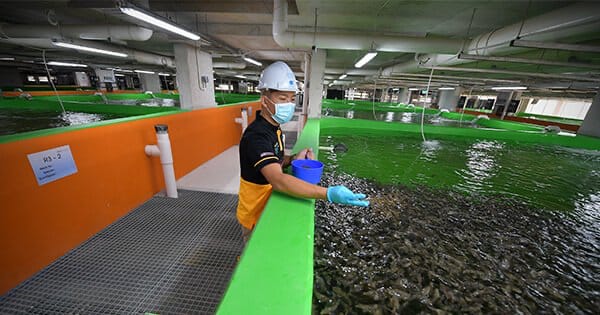 | 🐡 By the late 2010s, Apollo was growing not just groupers and snappers but even exotic things like hybrid coral trout, shrimp, and sturgeon in their systems. |
In 2012, Eric built a S$1 million experimental three-storey land-based fish farm at Lim Chu Kang. This wasn't just tanks stacked on top of each other — it was a fully automated, sensor-driven operation. Underwater sensors monitored everything — water temperature, salinity, oxygen levels, everything.
No antibiotics. No hormones. Pure, controlled farming.
The results were staggering. The farm could produce 150-250 kg of fish per cubic metre of water. Compare that to traditional sea cage farming in the ocean, which only yields 25-75 kg per cubic metre. They were crushing it — 6x more efficient.

8-storey vertical fish farm
🏔️ At its peak, Apollo was going to be Singapore’s tallest and most high-tech fish farm:
Singapore awarded Apollo 3 prime plots of land in Lim Chu Kang (including a large 23,961 sqm site), producing ~200 tonnes of fish annually.
Temasek (Singapore’s state investment firm) invested ~S$35 million (33.1% stake in Apollo through their subsidiary TLS Beta).
With Temasek’s investment, Apollo built a flagship 8-storey vertical fish farm (reportedly to cost $65-70 million) at Neo Tiew Crescent in Lim Chu Kang.
1,000 tonnes of fish in year one.
Scaling up to 2,700 tonnes annually by 2023 (once all 8 levels were filled with tanks).
For context, the entire country’s local fish farms produced only ~4,700 tonnes in 2019.
This new farm alone could double Singapore’s fish supply if all went well.
Everything was aligned. Government support. Sovereign wealth backing. Proven technology.
🇸🇬🎯 Apollo “almost” became the solution to Singapore's "30 by 30" goal — producing 30% of its nutritional needs locally by 2030.
📉 The Fall of Apollo Aquaculture Group
Yes, almost.
💥 They were so close to proving vertical farming could save Singapore’s food supply — until reality struck back, hard.
🚨 Just 18 months in, construction delays, massive cost overruns and production shortfalls sank the company. Even worse, legal troubles and corruption charges involving then-CEO Eric Ng later surfaced.
📌 Here’s what happened to Apollo Aquaculture Group:
🏗️ Stacking “fish condo” from 3-storey to 8-storey
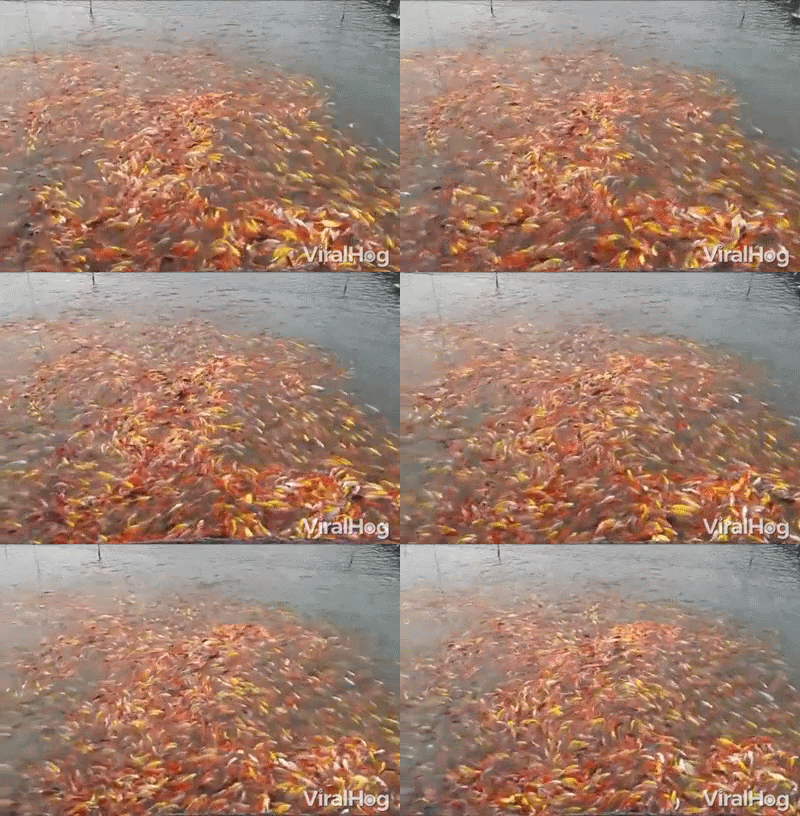
1969 — Apollo Aquarium (the precursor to Apollo Aquaculture Group) was founded by Mr. Ng Yong Hock, initially as a small farm exporting ornamental tropical fish like guppies and goldfish.
1995 — 🙏🏻 Ng’s son, Eric Ng (Ng Woei Kiat), forwent university overseas to join the family business at age 21, after some persuasion from dad.
He learned the ropes but quickly felt the industry must modernise.
2003 — After a short break working in construction, Eric returned to Apollo and started pushing for automation and new ideas to improve efficiency in fish farming.
2009 — 🐟 Built its first prototype land-based aquaculture system using a government grant.
This flat pilot system proved that recirculating water technology can work for farming saltwater fish indoors.
2015 — 🏢 Apollo achieved a major breakthrough by constructing a 3-storey vertical fish farm in Lim Chu Kang.
Eric Ng became the first in the world to successfully farm fish in a multi-storey RAS setup.
The pilot farm (3 levels, 6 tanks) could produce about 150 tonnes of fish per year, showing promise for high-density urban aquaculture.
2018 — 💰 Temasek’s agritech investment arm, Temasek Life Sciences Laboratory (through its unit TLS Beta), agreed to back Apollo’s ambitious new project — an 8-storey, S$65–70 million vertical fish farm as Singapore doubled down on its “30 by 30” local food production goal.
🚨In February 2025, Singapore media reported that prosecutors had charged Apollo’s former CEO Eric Ng with corruption, alleging he accepted a S$450,000 payment from a contractor in 2018
Q1 2021 — 🏢 The 8-storey Apollo fish farm at Neo Tiew Crescent officially began operations.
It was the tallest fish farm in Singapore and was showcased as a cutting-edge solution to overcome the nation’s land scarcity for food production.
The farm’s first phase produces hybrid grouper and coral trout, with an expected output of ~1,000 tonnes/year on the initial floors.
Plans were to scale up to 2,700 tonnes by 2023 when all floors were running.
Apollo Aquaculture Group was at its peak, gaining media attention and government praise as a frontrunner in agri-tech.
🐟 Fish tanks smell a bit fishy…

May 2022 — 💸 Apollo Aquaculture hit a wall — facing severe financial troubles, the company was placed under judicial management by the High Court.
An interim judicial manager (Deloitte) took over operations as Apollo couldn’t service its debts.
The root cause → construction delays and cost overruns on the new farm that drained Apollo’s funds.
Early 2023 — ☠️ Apollo Aquarium, the subsidiary operating the 8-storey farm, ceased all operations.
The high-tech facility was shut down, never having reached its production targets.
By this time, 4 of Apollo’s 5 subsidiaries (including its ornamental fish arm and hatchery) were in liquidation, leaving only the main farm entity under restructuring.
Apollo Aquaculture Group, as a business, had effectively collapsed.
17 Oct 2024 — 📉 In a last bid to salvage value, Apollo’s judicial managers sold the 8-storey fish farm to new owners at a steep loss.
HPC Builders (a construction firm) and Aquachamp (a fish farming investor) agreed to buy 100% of Apollo Aquarium for a total of S$3.5 million — a fraction of the ~$65 million invested in the project.
The farm’s book value was still $44 million as of March 2024, highlighting how desperate the sale is.
Singapore Food Agency approval is pending, but the deal signals the end of Apollo’s ownership of the farm.
20 Feb 2025 — 🚨🚨🚨 News broke that former CEO Eric Ng (Ng Woei Kiat) was allegedly charged with corruption.
He allegedly accepted a S$450k bribe in August 2018 from Alan Koh (of Alric Engineering) in exchange for not “disfavoring” that contractor in Apollo’s projects.
He was also charged with 7 charges under the Companies Act for failing to declare his personal interest in several Apollo transactions from 2018–2020.
🤦🏻♂️ For example, Apollo buying seafood like sea cucumbers and crabs from companies Eric secretly had stakes in.
The case was adjourned for trial, but it casts a shadow over Apollo’s management during its critical expansion years.
So, as with any early-stage tech investment, there is inherent risk, much more so than companies that have been long established. So, we should expect some companies to struggle or even fail. But, more importantly, how we look at it is as a portfolio asset, whether or not that portfolio has does well over time. And that is what, as an investor, we focus on.
Writing Apollo’s story reminds me of I.F.F.I (Singapore’s soil-based indoor farming) which also collapsed due to the high costs of production.
Apollo also faced governance questions during this period, as allegations of conflict-of-interest and corruption surfaced in media reports and court filings.
By the time the crisis hit, it was too late to turn back. Apollo Aquaculture Group ended up essentially bankrupt, its prized assets sold for pennies on the dollar, and its legacy tarnished by legal proceedings and corporate turmoil.
🙏🏻 But the good news is that the vertical fish farm that Apollo built will likely live on under new ownership (the buyers, HPC and Aquachamp, express optimism about finally getting it fully operational and profitable).
🤔 Do you think vertical fish farming is financially feasible in Singapore?
Want to learn more about Apollo Aquaculture Group’s downfall?
⚠️ 2 Mistakes

Former Group CEO of Apollo Aquaculture Group Ng Woei Kiat (left) was accused of receiving bribes from the director of two engineering companies Alan Koh Joon Seong (right) at the State Courts on Feb 20, 2025.
Mistake 1: Scaling before stabilising
After cracking the code with a 3-storey prototype that proved fish could be farmed vertically, Apollo went all-in.
Instead of refining that model or scaling modularly, they jumped straight to an 8-storey, S$65–70 million mega-farm. It was an audacious move — one that outpaced their operational maturity.
🙏🏻 They hadn’t yet proven consistent profitability on the smaller system, nor built the financial buffer to handle delays.
So when construction costs ballooned and production lagged, Apollo had zero margin for error.
Not just that, when electricity prices in Singapore surged dramatically due to global energy market shocks in mid-2022, Apollo's operational costs skyrocketed.
Within a year of the grand launch, they were in judicial management — essentially bankrupt while their farm was only partially functional.
Mistake 2: Poor governance & leadership integrity
In February 2025, founder and CEO Eric Ng was charged with corruption, with prosecutors alleging he accepted a S$450,000 bribe from a contractor during the construction of Apollo’s flagship fish farm and of allegedly secretly owning shares in vendors supplying to Apollo.
🤦🏻♂️ Prosecutors alleged the money was used to make a partial down-payment of S$471,000 for a condominium unit at 159 Wak Hassan Drive..
🤥 He was also charged with failing to declare his interest in related-party transactions. For example:
A company he was the de-facto owner of provided 5,360 kg of sea cucumbers to Apollo for S$310,000, and another company under his control provided hairy crabs for S$17,361.08 — all without proper disclosure to the board.
When governance cracks appear in a capital-intensive startup, confidence drains faster than cash — and Apollo’s brand value evaporated overnight.
🧠 3 Lessons Learned

Lesson 1: Deep dive into your cost structure (especially the hidden ones)
Proof of concept ≠ Proof of profitability
Apollo had built something revolutionary — the world’s first vertical fish farm — but they mistook technical validation for business validation.
🏗️ Apollo budgeted S$65-70 million for their eight-storey vertical fish farm, but delays in construction ballooned costs beyond control. Every extra month meant more spending on interest, staff, and maintenance, while zero revenue rolled in from the unfinished facility.
😳 They didn’t have stable unit economics, nor stress-tested operations for shocks like Singapore’s mid-2022 energy surge (which sent power bills soaring for all aquaculture firms).
Suddenly, every kilowatt-hour eaten by water pumps and oxygenators turned into bleeding costs.
🌮 Key Takeaways:
⚠️ Scenario plan for the worst (not the best)
Don’t only budget for “normal” years.
Always model worst-case cost shocks (fuel, logistics, customer churn) in your business.
🤑 Validate the economics of your smallest unit before replication
For Apollo, that meant knowing the per-tank ROI and time-to-harvest before multiplying it by 8 floors.
For tech founders, that’s your pilot customer unit.
If your smallest model isn’t profitable or operationally sound, scaling it just magnifies the losses.
📈 Scale slowly (but surely)
Competitors like Barramundi Group and Vplus Aquaculture built in stages (one modular system at a time) so they could adapt to real-world conditions (water quality, power cost, fish mortality).
It’s the same principle SaaS startups use — don’t hire 20 salespeople before one SDR proves the funnel works.
Lesson 2: Governance is non-negotiable
Even a game-changing company will implode if trust is broken at the top.
Implement airtight financial processes and always run independent audits, especially if you’re growing fast and handling public funds or government contracts.
🌮 Key Takeaways:
✊🏻 Separate control from creation
Founders often think “more control = more speed”, but in truth, strong internal checks increase survival odds.
In regulated sectors (like aquaculture, fintech, or med-tech), hire financial controllers early and empower them to say no.
👮🏻 Hire auditors early (not just for compliance)
Don’t wait until fundraising or M&A. An annual independent audit signals professionalism and detects early red flags.
If Apollo had engaged an external firm to vet procurement and contractor payments, the S$450,000 bribe might have been flagged years before charges surfaced.
Lesson 3: Innovation ≠ Immunity from fundamentals
Vision scales a company. Fundamentals sustain it.
Apollo’s founders were visionaries, no doubt. They built something no one else dared to — a skyscraper for fish. But vision can’t substitute for fundamentals — financial discipline, risk management, and stakeholder alignment.
The company was so focused on proving its technological edge that it forgot to build a resilient business engine underneath.
They chased scale of structure instead of scale of systems.
🌮 Key Takeaways:
👀 Innovation buys attention (not sustainability)
Apollo’s vertical farm won awards, media headlines, and investor buzz. But none of that mattered once cash flow turned negative.
Founders need to separate what’s innovative from what’s repeatable — the former gets you hype, the latter keeps you alive.
🧠 Always pair vision with risk planning
Every moonshot needs a parachute. Apollo banked on perfect conditions — stable energy, no cost overruns, smooth operations.
Founders should build “Plan B” cash buffers and downside scenarios early, especially when operating in high-cost environments.
🔥 Protect mission from ego
Apollo’s downfall wasn’t just about fish or finance — it was hubris.
The desire to make a global splash overshadowed the basics of running a business responsibly.
Great founders build for impact, not headlines.
🔗 The Runway Insights
💰 Southeast Asia Funding Radar
Pave Bank raises $39M to scale world’s first programmable bank built for digital assets and AI era (Link)
Sedifly bags 3x over-subscribed pre-seed round (6-figure) to democratise college admissions (Link)
ourteam raises a pre-seed funding led by First Move to make AI screening the new normal for hiring in Asia (Link)
Videotto raises seed funding to make video editing simple and effortless (Link)
🤝🏻 Before you go: Here are 2 ways I can help you
Founder Office Hours: Book a 1-1 call with me, share your problems and questions, and I'll help you cut through the noise, avoid costly mistakes, and get clear next steps that actually work. I help early-stage founders with:
Validating ideas & building MVPs
Tech & product development
GTM strategy & fundraising
Finding PMF & growth hacks
Growing & monetising newsletters
Attract customers & investors by building a solid founder brand on LinkedIn
Promote your business to 18,000+ founders: Acquire high-value leads and customers for your business by getting your brand in front of highly engaged startup founders and operators in Asia.
💃 Rate Today’s Edition
What'd you think of today's edition?Your feedback helps me create better content for you! |
That’s all for today
Thanks for reading. I hope you enjoyed today's issue. More than that, I hope you’ve learned some actionable tips to build and grow your business.
You can always write to me by simply replying to this newsletter and we can chat.
See you again next week.
- Admond
Disclaimer: The Runway Ventures content is for informational purposes only. Unless otherwise stated, any opinions expressed above belong solely to the author.
Reply