- The Runway Ventures
- Posts
- 🤯 Gobee.bike: When Bikes Started Landing in Rivers
🤯 Gobee.bike: When Bikes Started Landing in Rivers
Hong Kong’s first dockless bike-sharing startup exploded to 16 cities and 34,000 bikes — before vandalism and broken unit economics destroyed the business.

Admond Lee
March 08, 2026

Hey Founders,
Welcome to The Runway Ventures — a weekly newsletter where I deep dive into failed startup stories to help you become the top 1% founder by learning from their mistakes with actionable insights.
Better decisions come from being in the right room. Beyond Runway is that room — a private founder community for high-growth operators in Southeast Asia.
Our members are doing $100K-$20M annual revenue. Low-ego. High-trust. Extremely curated.
Today’s story is about how Hong Kong’s first bike sharing platform tried to revolutionise urban mobility but failed within 15 months. Let’s get to it! 🚀
Today at a Glance:
☠️ 1 Failed Startup → Gobee.bike
⚠️ 2 Mistakes → Unsustainable business model
🧠 3 Lessons Learned → Design your system assuming users will misbehave
🔗 The Runway Insights → $20K to $700K ARR in 6 Weeks Inside YC
💰 Southeast Asia Funding Radar → Aonic raises $10M (Series A) to take home-grown drone technology global
☠️ 1 Failed Startup: Gobee.bike

🚀 The Rise of Gobee.bike
🇭🇰 Founded by Raphaël Cohen (CEO) and Claude Ducharm (CTO) in 2017, Gobee.bike was Hong Kong’s first bike sharing company.
🕺🏻 Founders’ Story
When Raphaël Cohen noticed the explosive growth of dockless bike-sharing in China, especially companies like Ofo and Mobike, he believed the same idea could solve Hong Kong’s “last-mile” problem — the gap between train stations and people’s homes.
🚴🏼♂️ Together with co-founder Claude Ducharme, they launched Gobee in April 2017 with about 1,000 bright green bikes in the New Territories, allowing users to unlock bikes via a QR code and park them anywhere.
The idea quickly caught attention as Hong Kong’s first dockless bike-sharing service.
The Problem — 🥵 In Hong Kong, there’s always that annoying “last mile” between the train station and your final destination.
Walking in Hong Kong’s hot, humid weather isn’t pleasant, taxis are expensive for short trips, and buses or minibuses can be slow for short distances.
Traditional bike rentals were inconvenient because you had to rent and return the bicycle at the same shop, often leaving an ID or deposit.
The Solution — 🚲 Gobee.bike introduced Hong Kong’s first dockless bike-sharing system.
Users could open the Gobee app, locate nearby bikes via GPS, scan a QR code to unlock the bike, ride it to their destination, and park it at any legal public bicycle spot.
The bikes used smart locks with GPS and solar-powered technology, making the system fully automated without docking stations.
Rides cost around HK$5 per 30 minutes, making it an affordable and flexible way to travel short distances.
🚴🏻♀️ In simple words, Gobee was a dockless bike-sharing startup that let people unlock bikes with a mobile app and ride short distances around the city for a small fee.
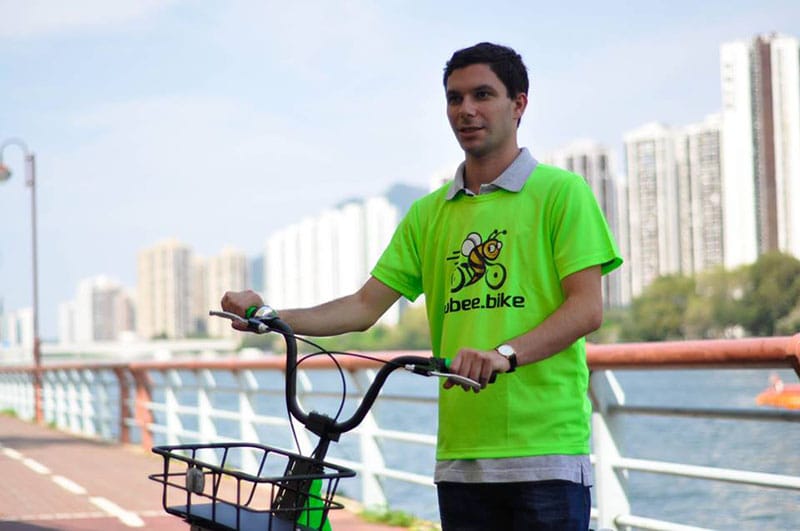 Raphael Cohen (Founder & CEO of Gobee.bike)
| 🔥 In April 2017, they launched in the New Territories by deploying 1,000 bikes to Sha Tin, Tai Po and Ma On Shan. Well, guess what? It exploded in popularity. Everyone was talking about it. Everyone was riding it. 🤳 By mid-2017, they got 100,000+ app downloads with thousands of bikes deployed. |
🤑 Then, investors piled in. Gobee raised $9 million (Series A) in August 2017 (4 months after the launch) from top investors like Grishin Robotics and Alibaba Hong Kong Entrepreneurs Fund.
By late 2017, Gobee had:
7,000 bikes operating in Hong Kong
300,000 app downloads
tens of thousands of daily rides
Not just that, they wanted to go global. So they launched in Europe to multiple cities like Paris, Milan, Rome, and Brussels.
At it peak, Gobee expanded to:
|  |
Gobee became the first Asian bike-share company to hit Paris, beating the mainland giants like Ofo and Mobike to the punch.
That was the peak. They were invincible.
📉 The Fall of Gobee.bike
But behind the peak, everything else started breaking behind the scene.
🥊 Vandalism. Theft. Rising maintenance costs.
All these destroyed thousands of bikes across multiple cities.
These are external factors. Internally, the unit economics never actually worked.
📌 Here’s what happened to Gobee.bike:
Over the months of December and January, the mass destruction of our fleet has become the new entertainment of underaged individuals.
🚲🚲🚲 Bikey, bikey bikey

Feb 2017 — Gobee.bike founded by Raphaël Cohen and Claude Ducharme.
Apr 2017 — 🇭🇰 Launched in Hong Kong with about 1,000 bikes
First vandalism incidents occur within days of launch.
Aug 2017 — 💰 Raised $9M (Series A) funding led by Grishin Robotics and Alibaba HK Fund.
Oct 2017 — 🌍 Expansion into Europe began.
Nov 2017 — Fleet reached 7,000 bikes in Hong Kong.
😠🚳 Ride, dump, maintain, ride, dump again…

Jan 2018 — 🤕 Withdrawn from Brussels, Lille, and Reims due to vandalism after 80–90% of its bikes there were stolen or damaged.
Feb 2018 — European operations collapsed after large-scale theft and damage.
10 Jul 2018 — 🚳 Announced shutdown in Hong Kong due to financial losses.
17 Jul 2018 — Gobee.bike officially shut down globally and invited users to claim their HK$399 deposit back.
Gobee.bike had:
a great product
strong investors
early traction
global expansion
But it got hit by the brick wall of human nature and cold, hard economics (similar fate happened to SG Bike that we shared before).
🙏🏻 You can have the best app and the best investors, but if your business model depends on everyone "playing nice" with your equipment, you might be in for a very bumpy ride.
Want to learn more about Gobee.bike’s downfall?
⚠️ 2 Mistakes

River dumping cases (vandalism against Gobee.bike)
Mistake 1: Unsustainable business model
After over a year in service, we unfortunately have not been able to make the service profitable, and the financial costs of maintaining the bikes in their best condition has proven to be too high for us to sustain the business.
A bike-sharing business is brutally simple → you buy a physical asset, place it in the real world, collect small fees per ride, then hope lifetime revenue per bike is higher than the total cost of buying, moving, repairing, and replacing it.
Similar to SG Bike, it was an asset-heavy, operations-heavy, field-execution business.
Gobee charged HK$5 per 30 minutes:
If a bike was used 3 hours per day, it generated about HK$30/day.
But with an estimated HK$2,500 bike cost (≈HK$3.40/day over 2 years) plus about HK$30/day in operations, total cost was roughly HK$33/day.
That means each bike was already losing ~HK$3 per day (even before vandalism or theft) so scaling the fleet simply scaled the losses.
Every new city meant more bikes, more logistics, more maintenance staff, more theft exposure, more regulatory complexity, and more working capital tied up in metal on the street.
If the economics were already fragile in Hong Kong, expanding to Paris, Brussels, Rome, and other cities only multiplied the losses.
Mistake 2: A business that relied on good public behaviour
Gobee placed thousands of bikes in open public spaces but built a model that assumed people would treat them responsibly.
In reality, shared assets in public environments are frequently abused — leading to vandalism, theft, and misuse.
Because Gobee lacked strong controls (durable bikes, parking enforcement, accountability systems), the model became extremely fragile, and the cost of repairing and replacing damaged bikes quickly destroyed the economics.
🧠 3 Lessons Learned

Lesson 1: Prove the unit economics first before scaling
Gobee expanded across cities and countries before proving whether each bike could generate sustainable profit.
Successful operators today do the opposite: they validate unit economics at small scale first, often city-by-city or district-by-district.
🤝🏻 For example, Singapore regulators now force bike-sharing startups to start with small fleets (~1,000 bikes) before scaling. Operators must prove they can manage utilisation, parking behaviour, and fleet maintenance before expansion.
This approach forces companies to solve the economics before scale multiplies the problems.
🌮 Key Takeaways:
In hardware or mobility businesses, asset-level profitability matters more than growth metrics.
Scaling fleets without validated utilisation will magnify losses.
Cities behave differently — a model that works in Singapore may fail in Bangkok.
🛠️ Operator Playbook:
💵 Run a “District Profitability Pilot” first
Launch a controlled fleet of 50–200 bikes in a single high-density area.
Track these metrics weekly (revenue per bike per day, rides per bike per day, repair rate per bike, idle rate, and vandalism rate).
Only expand when the unit economics work.
🚲 Expand density before geography
Higher bike density improves utilisation, which improves economics.
For example, Citi Bike grew station density in NYC before expanding to new boroughs.
Lesson 2: Design your system assuming users will misbehave
Gobee assumed riders would park bikes responsibly.
But the reality proved otherwise.
Successful bike-sharing platforms now embed control mechanisms directly into the product.
🌮 Key Takeaways:
Shared assets must assume misuse as the default case.
Hardware businesses must be built for defensive operations.
Systems should enforce behaviour automatically.
🛠️ Operator Playbook:
🚧 Use geo-fenced parking zones
Many successful operators now require bikes to be parked within specific areas.
For example, Neuron scooters enforce no-ride zones, slow zones, no-parking zones to prevent bikes from being abandoned randomly.
🤳 Implement parking QR codes
Singapore’s bike-sharing systems require riders to scan a QR code at a designated parking area to end their ride.
This system pushed >90% of trips into proper parking zones.
Anywheel is using this method to reduce parking chaos.
Lesson 3: The problem must be frequent enough to become a daily habit
Gobee solved a logical problem: the “last mile.”
But in Hong Kong the problem wasn’t painful enough to drive daily behaviour change.
Successful mobility startups focus on high-frequency use cases instead of relying on occasional leisure rides.
🌮 Key Takeaways:
A viable mobility business needs daily commuting behaviour, not weekend usage.
Frequency drives revenue and sustainability.
If users only ride occasionally, the business cannot survive.
🛠️ Operator Playbook:
🚇 Target commuter corridors first
Deploy fleets in university campuses, business districts, and dense residential areas.
These locations produce predictable daily demand.
🤑 Incentivise riders to rebalance the fleet
Citi Bike runs a program called Bike Angels, where users earn rewards for moving bikes from crowded stations to empty stations.
This reduces operational costs by turning users into a distributed logistics network.
🔗 The Runway Insights
💰 Southeast Asia Funding Radar
Aonic raises $10M (Series A) to take home-grown drone technology global (More)
MyFirst raises $8M (Series A) to make more kid-safe tech (More)
Diaflow secures seed funding to accelerate AI adoption in business workspace (More)
Dyna.ai raises Series A to turn enterprise AI pilots into real business results (More)
💃 Rate Today’s Edition
What'd you think of today's edition?Your feedback helps me create better content for you! |
That’s all for today
Thanks for reading. I hope you enjoyed today's issue. More than that, I hope you’ve learned some actionable tips to build and grow your business.
You can always write to me by simply replying to this newsletter and we can chat.
See you again next week.
- Admond
Disclaimer: The Runway Ventures content is for informational purposes only. Unless otherwise stated, any opinions expressed above belong solely to the author.
1
Reply